Loading organizations...
§ Private Profile · San Francisco, CA, USA
Build Agents That Recall What Matters. End-to-End Context Engineering…
Zep AI has raised $500K across 1 funding round.
Key people at Zep AI.
Zep AI was founded in 2023 by Daniel Chalef (Founder).
Zep AI has raised $500K in total across 1 funding round.
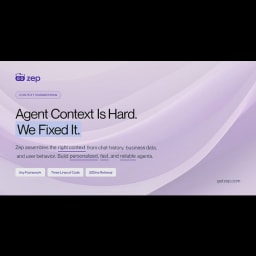
Build fast, accurate, and personalized agents with the only platform that systematically engineers relevant context from chat history and business data. Skip building complex personalization infrastructure, focus on your product instead.
Zep includes three core components:
- Agent Memory - Transforms conversations, business data, & user interactions into a living knowledge graph that evolves with every interaction
- Graph RAG - Connects your business data through relationships so agents retrieve relevant information in milliseconds, even as your data changes
- Context Assembly - Combines memory and business data into optimized context for your LLM
What you get:
- Personalized Context Engineering - 100%+ accuracy improvements through temporal knowledge graphs that combine user memory with business data
- Rapid Implementation - Deploy personalized agents in days using simple APIs, not months of infrastructure work
- Enterprise-Ready Performance - 90% latency reduction with 98% token efficiency, plus SOC2 Type 2 and HIPAA compliance
- Universal Integration - TypeScript, Python, and Go SDKs work with any LLM and framework including LangChain
Key people at Zep AI.
Zep AI has raised $500K across 1 funding round. Most recently, it raised $500K Seed in March 2024.
| Date | Round | Lead Investors | Other Investors | Status |
|---|---|---|---|---|
| Mar 1, 2024 | $500K Seed | — | Y Combinator | Announced |
Zep AI was founded in 2023 by Daniel Chalef (Founder).
Zep AI has raised $500K in total across 1 funding round.
Zep AI's investors include Y Combinator.
Zep AI builds advanced AI agents that recall and utilize relevant context by engineering an end-to-end memory and knowledge graph infrastructure. Their platform systematically integrates user conversation history with business data to create dynamic, temporal knowledge graphs that enable AI agents to deliver personalized, accurate, and context-aware experiences. This approach solves the challenge of AI agents forgetting or misinterpreting evolving user information, enhancing their ability to complete tasks effectively across various domains[1][3][5].
For an investment firm, Zep AI represents a cutting-edge player in the AI infrastructure and agent memory space, focusing on context engineering—a critical enabler for next-generation AI applications. Their technology serves developers and businesses building AI assistants and agents that require deep understanding of user preferences and business scenarios. The company’s impact on the startup ecosystem lies in advancing AI memory capabilities, fostering more intelligent, personalized AI interactions, and enabling new classes of AI-powered products[1][2][5].
Zep AI was founded by Paul, Preston, and Daniel, who brought expertise in AI, knowledge graphs, and large language models (LLMs). The idea emerged from the need to improve AI agents’ memory beyond simple chat history, addressing the problem of maintaining accurate, evolving user context over time. Early traction included open-sourcing Graphiti, a Python library for building temporal knowledge graphs, which underpins Zep’s memory layer and showcases their technical innovation. The company has evolved from a specialized retrieval-augmented generation (RAG) pipeline to a sophisticated knowledge graph platform that handles dynamic relationships and historical context[5][1].
Zep AI rides the wave of increasing demand for AI agents that do more than respond—they must *remember* and *understand* users deeply. The timing is critical as AI adoption accelerates across industries, and static or short-term memory limits AI usefulness. Market forces such as the rise of LLMs, conversational AI, and personalized automation favor solutions that provide persistent, contextual memory. Zep’s knowledge graph approach influences the ecosystem by setting new standards for AI memory, enabling more natural, effective human-AI interactions and powering innovations in customer service, social platforms, and enterprise AI[1][2][4][5].
Looking ahead, Zep AI is poised to expand its platform capabilities, deepen integrations with business data sources, and broaden accessibility through no-code tools, as seen in partnerships like FlockX. Trends shaping their journey include growing expectations for AI personalization, advances in knowledge graph technology, and the proliferation of AI agents in everyday applications. Their influence will likely grow as they enable developers to build AI agents that not only recall what matters but also reason over complex, evolving contexts—transforming how AI supports human tasks from mundane to monumental[6][3][5].
This trajectory ties back to Zep’s mission of building the foundational context engineering infrastructure that powers truly intelligent AI agents, marking them as a key innovator in the AI memory and agent space.